

Sorting is one of the most common operations in software development. Whether you’re ordering search results, ranking users, or organizing data for display, sorting logic plays a critical role in application behavior and performance.
In Java, sorting custom objects often raises an important question: Should you use Comparable or Comparator?
Although both serve the same purpose, they solve different design problems and are frequently misunderstood.
This article explains how Java sorting works internally and how Comparable and Comparator fit into real-world software design.
Why Sorting Custom Objects Is Different
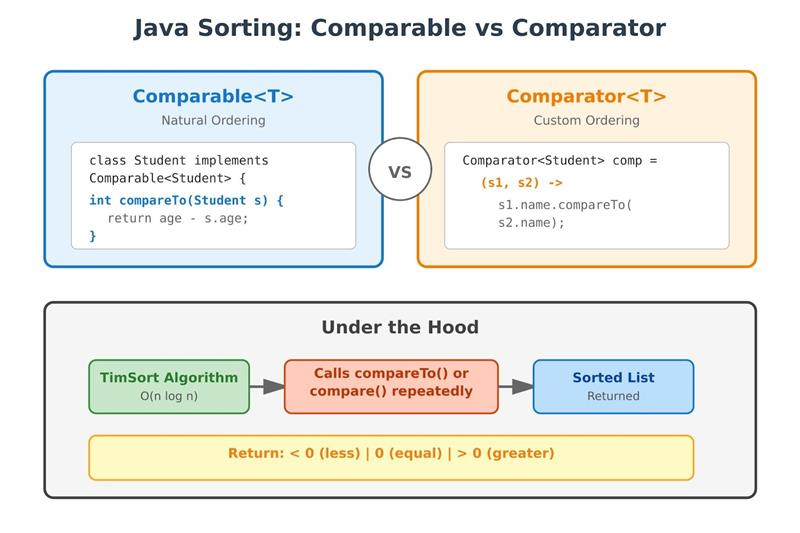
Primitive data types like int or String already have a natural ordering. But when working with custom objects—such as Employee, Order, or Product—Java needs explicit instructions on how to compare them.
This is where Comparable and Comparator come into play.
Comparable: Defining Natural Order Inside the Class
The Comparable interface is used when an object has a single, natural ordering.
Key characteristics:
- Implemented inside the class
- Uses the compareTo() method
- Modifies the class definition
- Ideal when objects have one obvious way to be sorted
Example use cases:
- Sorting employees by ID
- Sorting products by price
- Sorting users by registration date
Because the sorting logic lives inside the class, Comparable tightly couples ordering behavior with the object itself.
Comparator: External and Flexible Sorting Logic
The Comparator interface is used when objects can be sorted in multiple ways.
Key characteristics:
- Implemented outside the class
- Uses the compare() method
- Does not modify the original class
- Allows multiple sorting strategies
Example use cases:
- Sorting employees by name, salary, or department
- Sorting orders by date, amount, or priority
- Applying different sorting rules in different contexts
Comparator is more flexible and aligns well with modern software design principles.
Comparable vs Comparator: Design Perspective
From a clean architecture standpoint:
- Comparable is best when ordering is intrinsic to the object
- Comparator is better when ordering depends on business context
In large systems, Comparator is often preferred because it avoids modifying domain models for every new sorting requirement.
A detailed breakdown of their differences, use cases, and performance considerations is explained here:
👉 Comparable vs Comparator in Java (with examples and internal behavior)
Impact on Performance and Maintainability
Although both approaches rely on comparison operations, performance differences are usually negligible. The real impact is on code maintainability:
- Comparable can become restrictive as requirements grow
- Comparator scales better with changing business rules
- Comparator supports cleaner separation of concerns
For enterprise applications, Comparator-based sorting is generally more future-proof.
Best Practices for Production Systems
- Prefer Comparator when sorting rules may evolve
- Avoid modifying domain classes just to support sorting
- Use lambda expressions for concise Comparator definitions
- Keep sorting logic close to where it’s used
Final Thoughts
Sorting is more than a utility operation—it’s a design decision. Understanding when to use Comparable versus Comparator helps developers write cleaner, more maintainable, and more flexible Java applications.
Choosing the right approach early can save refactoring effort and reduce technical debt as systems scale.